
DNS After Graduation
Students come across the Merchant Navy when they have already graduated and want to know if they can join the Diploma in Nautical Science (DNS) pathway. Graduation does not immediately make a person disqualified from joining DNS. What is significant here is the type of degree obtained by the applicant and whether it is one of the alternative qualifications recognized for DNS.
According to the IMU 2026-27 Admission Prospectus, some graduates can be considered eligible for the DNS program leading to B.Sc. (Applied Nautical Science) through the alternative qualification path. These include students who have completed a B.Sc. in Physics, Mathematics, Chemistry, or Electronics, satisfying the required marks criterion, or a B.E./B.Tech. from IITs or any other AICTE-recognized colleges.
So, simply having any graduation degree does not make a candidate eligible for DNS.
Can a Graduate Apply for DNS?
Yes, but the degree must fall under one of the categories specified by the applicable admission rules.
For the 2026–27 DNS admission framework, the graduate-entry options include
- B.Sc. in Physics
- B.Sc. in Mathematics
- B.Sc. in Chemistry
- B.Sc. in Electronics, with Physics as an individual subject in one of the years
- B.E./B.Tech. from an IIT
- B.E./B.Tech. from an AICTE-recognized college
The prescribed mark requirements also apply. A candidate should not assume that completing a B.Com, BBA, BA, or another unrelated bachelor’s degree creates eligibility for DNS.
DNS Eligibility After Graduation
The current IMU prospectus provides the following graduate-entry pathway for the one-year DNS program leading to B.Sc. (Applied Nautical Science):
Qualification | Minimum requirement |
B.Sc. Physics | 55% average in final year |
B.Sc. Mathematics | 55% average in final year |
B.Sc. Chemistry | 55% average in final year |
B.Sc. Electronics | 55% average in the final year, with physics as an individual subject in one of the years |
B.E./B.Tech. from IIT | 50% average in final year |
B.E./B.Tech. from an AICTE-recognized college | 50% average in final year |
English | 50% in the Class 10/12 degree examination |
The candidate must also satisfy the applicable age, marital status, and medical requirements.
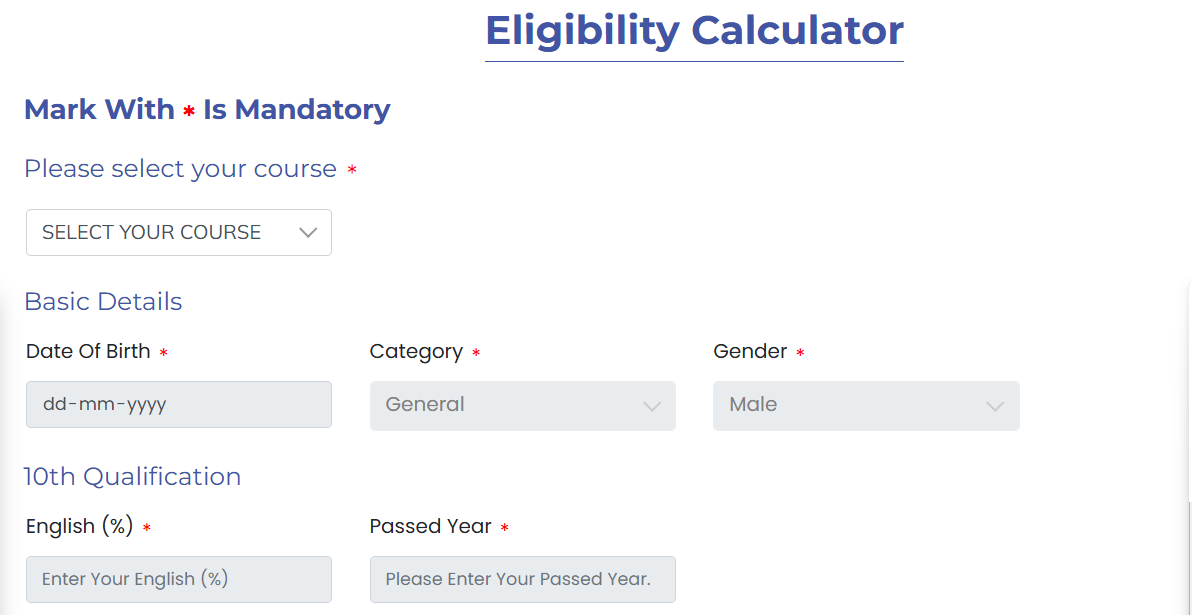
Want to check whether you meet the DNS eligibility requirements? You can use the Merchant Navy Decoded Eligibility Calculator to enter your academic and basic details and get an eligibility check for relevant maritime courses.
Can You Do DNS After Any Graduation?
Wrong. This is one of the most crucial considerations for graduates thinking of changing careers.
It is not that a graduate will be eligible for the graduate entry program because he/she has a bachelor’s degree. IMU specifies certain degree streams.
Example:
- B.Sc. Physics: Can come under the graduate entry stream.
- B.Sc. Mathematics: Can come under the graduate entry stream.
- B.Sc. Chemistry: Can come under the graduate entry stream.
- B.Sc. Electronics: Can come under the graduate entry stream provided the physics qualification is met.
- B.E./B.Tech: Can come under the graduate entry stream provided the institutional qualifications as well as the mark qualifications are met.
- B.Com/BBA/BA: Not specified as qualifying degrees under this graduate entry DNS stream.
Candidates with an unrelated bachelor’s degree should not assume that graduation alone is enough.
Can a B.Tech Graduate Join DNS?
Yes, provided that certain conditions are met in the relevant prospectus.
IMU considers a B.E. or B. Tech degree from an IIT or an AICTE-approved institution to be another qualification option for 2026-27 DNS entry, where there is an average minimum of 50% marks in the final year. In addition to this, candidates should secure at least 50% marks in English in Class 10/Class 12 or degree exams.
This will serve as a path for engineering students who wish to switch to the deck side of the Merchant Navy later.
Can a B.Sc. Graduate Join DNS?
Yes, but the subject of the B.Sc. matters.
The current graduate-entry criteria specifically recognize B.Sc. degrees in:
- Physics
- Mathematics
- Chemistry
- Electronics
For these degrees, the required average is not less than 55% in the final year. For B.Sc. Electronics, Physics must have been studied as an individual subject in one of the years.
Table of Contents
Can a B.Com. graduate join DNS?
The B.Com qualification is not mentioned as an eligible graduate degree for graduate entry into DNS according to the IMU prospectus 2026/2027.
The graduate entry requirement explicitly mentions certain B.Sc. qualifications and B.E./B.Tech. qualifications. An applicant with any other qualifications shall not apply under the impression that his/her bachelor’s qualification alone meets the DNS academic requirement.
Can a BBA Graduate Join DNS?
A BBA course is also not included in the graduate courses mentioned for this DNS path.
The completion of the graduate course by the candidate does not make him/her exempt from meeting subject-specific criteria for DNS. The candidate should verify if he/she qualifies via the 10+2 PCM path or any other recognized eligibility path apart from his/her graduation course.
What If You Have a Degree but Also Have PCM in Class 12?
This can be important. The DNS eligibility framework provides a 10+2 route as well as specified graduate-entry routes.
Under the standard 10+2 route, candidates need:
- 10+2/equivalent
- Physics, Chemistry, and Mathematics
- 60% average in PCM
- 50% in English in Class 10 or Class 12
The graduate route has different qualification and mark requirements. So, if a graduate already meets the standard 10+2 DNS eligibility, that academic route may also be relevant.

Is IMU-CET Required After Graduation?
It is recommended for candidates to go through the admission notice for the specific batch since the requirement of the entrance will depend on IMU’s admission policy.
DNS is one of the UG courses that is conducted via IMU-CET for the present 2026-27 session cycle. IMU’s admission portal mentions DNS along with other programs like B.Tech and B.Sc programs as part of 2026 CET admissions.
It is not mandatory that a candidate who is a graduate automatically qualifies to bypass the DNS entrance process.

JMDI IMU-CET Preparation Book
For students preparing specifically for IMU-CET, JMDI and Merchant Navy Decoded also offer an IMU-CET preparation book.
The official JMDI page describes the book as covering concept-based learning, chapter-wise practice, previous-year question analysis, and full-length mock-test preparation. The price can change with offers. The current official listing shows the book at ₹1,599, although it may commonly be referred to as the approximately ₹1,500 book.
Official book page: JMDI IMU-CET Book
What Is the Age Limit for Graduate Entry?
Age is particularly important for graduates because a candidate may already be several years older than a Class 12 applicant.
For the 2026–27 DNS program, IMU specifies the maximum age as
Category | Male | Female |
General | 25 years | 27 years |
OBC (NCL) | 28 years | 30 years |
SC/ST | 30 years | 32 years |
The age is calculated with reference to the commencement of the academic session. This means an academically eligible graduate may still be unable to apply if they exceed the applicable age limit.
Is Medical Fitness Required After Graduation?
Yes. Even after graduation, the medical requirements of the maritime course are not exempted.
Applicants who enroll in DNS are required to satisfy the physical fitness and visual requirements that apply to seafarers. Medical standards that may be set by IMU for the applicants selected to join the program must be certified by an approved DG Shipping physician.
Some of the medical standards that may be set are:
- Vision standards
- Color vision standards
- Hearing standards
- Physical fitness standards
Is Sponsorship Required for DNS After Graduation?
For DNS of institutes affiliated with IMU, sponsorship becomes a necessity in light of the existing admission policy. IMU’s Academic Circular No. 2611, dated 16 July 2026, pertains specifically to admissions for DNS 2026–27 at affiliated colleges for sponsored students only.
Sponsorship is different from eligibility requirements.
- Even after obtaining a degree, the candidate needs to fulfill the following:
- DNS eligibility
- Entrance requirement fulfillment
- Wherever required, get the sponsorship
- Medical eligibility
- Institute’s admission procedures
How Does DNS Sponsorship Work for Graduates?
A sponsoring company may conduct its own selection process.
Depending on the company, this may involve the following:
- Written examination
- Aptitude assessment
- Interview
- Psychometric assessment
- Medical examination
- Document verification
The exact selection procedure differs between companies. Graduates should also remember that having an engineering or science degree does not automatically guarantee sponsorship.
DNS After Graduation vs. DNS After 12th
There is a difference between entering DNS directly after school and entering through the graduate route.
After 12th | After Graduation |
10+2 with PCM required | Only specified degrees qualify under the graduate route. |
60% PCM required | B.Sc. route: 55% final year |
50% English | 50% English in 10th/12th/13th degree |
An age limit applies. | Age limit can become a major consideration. |
The IMU-CET requirement applies. | Applicable IMU-CET/admission requirements still need to be followed |
Sponsorship required for affiliated DNS institutes | Sponsorship required for affiliated DNS institutes |
The graduate route is therefore not a completely separate shortcut into DNS.
How Long Is DNS After Graduation?
However, the program itself is a 1-year program when taken as a pre-sea program.
A postgraduate qualification would not make the program shorter. Once the student completes the pre-sea program, the student has to satisfy the other criteria, including on-board training for sea service prior to being promoted through the deck officer career pathway.
What Do You Study During DNS?
A graduate entering DNS will still study the professional subjects required for nautical training.
These include areas such as
- Navigation
- Seamanship
- Ship stability
- Ship construction
- Cargo operations
- Maritime safety
- Meteorology
- Maritime communication
- Maritime regulations
- Watchkeeping
- Navigation equipment
The purpose of DNS is to develop the nautical knowledge and practical skills needed for the deck department.
Career After DNS
After completing the required training, sea service, and certification stages, candidates can progress through the deck-officer career pathway.
The progression can include:
- Deck Cadet
- Third Officer
- Second Officer
- Chief Officer
- Master/Captain
The progression depends on the required sea service, examinations, and certificates of competency. A graduate entering DNS does not automatically enter the Merchant Navy as an officer simply because they already hold a bachelor’s degree.
Should You Do DNS After Graduation?
It depends on your existing qualifications and career plans.
DNS may make sense for someone who:
- Has a qualifying science or engineering degree.
- Is within the applicable age limit.
- Meets the medical requirements.
- Is genuinely interested in a career at sea.
- Understands the training and sea-service requirements.
- Is prepared for the sponsorship and admission process.
It is less suitable if someone is choosing it simply because they expect an immediate high-paying job after a one-year course. Life at sea involves long periods away from home, disciplined routines, and professional responsibilities. A student should understand these aspects before committing to the career.
What If Your Graduation Degree Is Not Eligible?
In case your degree does not come under the mentioned graduate-entry criteria, one should note that one cannot directly rely on using that degree to enter into DNS.
Also, one can look at checking for meeting the other criterion, i.e., the PCM 10+2 route eligibility.
However, if one fails to satisfy any of the two criteria, then DNS may not be accessible via the present criteria. The criteria may also vary from one admission cycle to another. Hence, candidates need to refer to their respective prospectus.
JMDI Academy for DNS Admission Preparation
JMDI Academy, Dehradun, provides preparation support for students targeting Merchant Navy entrance examinations and company sponsorships.
For aspirants, preparation can include PCM, English, aptitude, mock tests, communication, and interview practice. Preparing for sponsorship and IMU-CET together can help students avoid treating the two processes as completely separate examinations.
Students preparing for DNS Sponsorship can also explore JMDI Academy’s preparation resources, including its IMU-CET book and test series, to strengthen their exam preparation through regular practice, MCQs, sample papers, and mock tests. Along with preparation resources,Apply now with JMDI Academy to begin your preparation with the right guidance and study resources.
Merchant Navy Decoded App for IMU Aspirants
The Merchant Navy Decoded App is another useful resource for students preparing for the Merchant Navy admission pathway.
The app provides Merchant Navy-related information and preparation resources, including an IMU-CET test series. Regular mock-test practice can help students improve speed and identify weak areas before the examination.Students can combine this with sponsorship-focused preparation and interview practice for a more complete preparation strategy.

Final Thoughts
Yes, you can enroll in a DNS program even after completing your undergraduate studies, but there are certain restrictions on the types of bachelor’s degrees.
In the current admission cycle of 2026-27 at IMU, the eligibility criteria for DNS include those who have a qualifying B.Sc. in Physics, Mathematics, Chemistry, or Electronics, fulfilling the conditions set forth, and also candidates having a qualifying B.E./B.Tech. degree from IITs and AICTE-recognized institutions.
Graduate students have their own mark criteria, English language criteria, and age criteria. Medical fitness continues to be a prerequisite, and sponsorship is essential for DNS admission through IMU-affiliated institutes in the current cycle of 2026-27.
A bachelor’s degree can serve as a pathway to DNS, but it cannot be said that it helps in avoiding the requirements of maritime education.

FAQ’s (Frequently asked Questions)
Yes. B.Sc. Physics is one of the science degrees listed under the current graduate-entry DNS eligibility, provided the candidate meets the required final-year marks and other conditions.
Yes, a B.Sc. in Mathematics is included in the specified graduate entry qualifications, subject to the prescribed marks and other requirements.
Yes, a B.E./B.Tech degree from an IIT or an AICTE-recognized college can meet the graduate-entry academic requirement, subject to the prescribed marks and other eligibility conditions.
B.Com is not listed among the graduate qualifications under the current IMU graduate-entry DNS criteria. A candidate would need to check whether they qualify through another recognized route.
No. The DNS program still has an applicable maximum age, and the limit is particularly important for graduates who are entering the field later.
Yes. Candidates must satisfy the applicable DG Shipping medical and eyesight standards and provide the required medical fitness certificate.
No. DNS is a one-year pre-sea program leading into the applicable nautical training and certification pathway, while B.Sc. Nautical Science is a separate degree program with a different course structure.
No. Sponsorship is a separate selection process. A graduate still needs to meet the sponsoring company’s requirements and clear its selection procedure where sponsorship is required.