
Marine Engineering Admission Process

Many students opt for marine engineering as their career option, where they will get an opportunity to apply their engineering skills for careers in the marine sector. If you have passed your Class 12 exams with PCM, then a B.Tech. in Marine Engineering is one of those career opportunities that you should definitely consider. But it takes more than passing Class 12 exams to gain admission into marine engineering colleges. Candidates must fulfill the eligibility requirements, crack the entrance test, go through the admission process, and fulfill the health fitness requirements too.
Here we discuss the whole admission process for the marine engineering program in India.
What Is B.Tech. Marine Engineering?
B.Tech. Marine Engineering is a four-year undergraduate engineering program that prepares students to work with the machinery and technical systems used on ships.
The course includes subjects such as:
- Marine diesel engines
- Thermodynamics
- Marine electrical systems
- Ship construction and naval architecture
- Marine boilers and steam systems
- Ship machinery maintenance
- Marine engineering design
It is a combination of class education and hands-on experience in addition to learning about safety measures, the shipping process, and the duties of a marine engineer. On completion of this course and after passing the appropriate examination for certification, students can build a career as marine engineers in merchant vessels.
Indian Maritime University (IMU) provides B.Tech. Marine Engineering courses at its various institutions as well as at affiliated institutions, providing maritime education.
Marine Engineering Eligibility Criteria
Prior to applying for the course of Marine Engineering, students must ensure that they fulfill all of the educational, age, and medical eligibility criteria.
The following criteria for eligibility are in accordance with the eligibility criteria provided by the IMU B.Tech. in Marine Engineering.
1. Educational Qualification
Candidates must have completed Class 12 or an equivalent examination from a recognized board. Physics, chemistry, and mathematics must be compulsory subjects.
The usual minimum academic requirements are:
Requirement | Minimum marks |
PCM aggregate | 60% |
English | 50% in Class 10 or Class 12 |
IMU provides a 5% relaxation in PCM marks for SC/ST candidates. This relaxation does not apply to English marks.
2. Age Limit
The age criteria depend on the candidate’s category and gender.
The published IMU criteria have included the following upper age limits:
Category | Male | Female |
General | 25 years | 27 years |
OBC (NCL) | 28 years | 30 years |
SC/ST | 30 years | 32 years |
The minimum age is generally 17 years.
The age is calculated using the reference date specified in the admission prospectus. Therefore, students should not calculate their eligibility using their age on the application date alone.
3. Medical Fitness
It is a sea-related course, and therefore medical fitness plays a key role in the selection process. This is because applicants must fulfill the requirements of medical fitness for the course.
The medical examination may cover:
- General physical fitness
- Vision and color vision
- Hearing
- Overall health and physical condition
B.Tech. in Marine Engineering vision criteria may not be the same as B.Sc. in Nautical Science/DNS. Applicants must know about the current medical criteria and get advice from a medical examiner.
Check Your Eligibility Before Applying
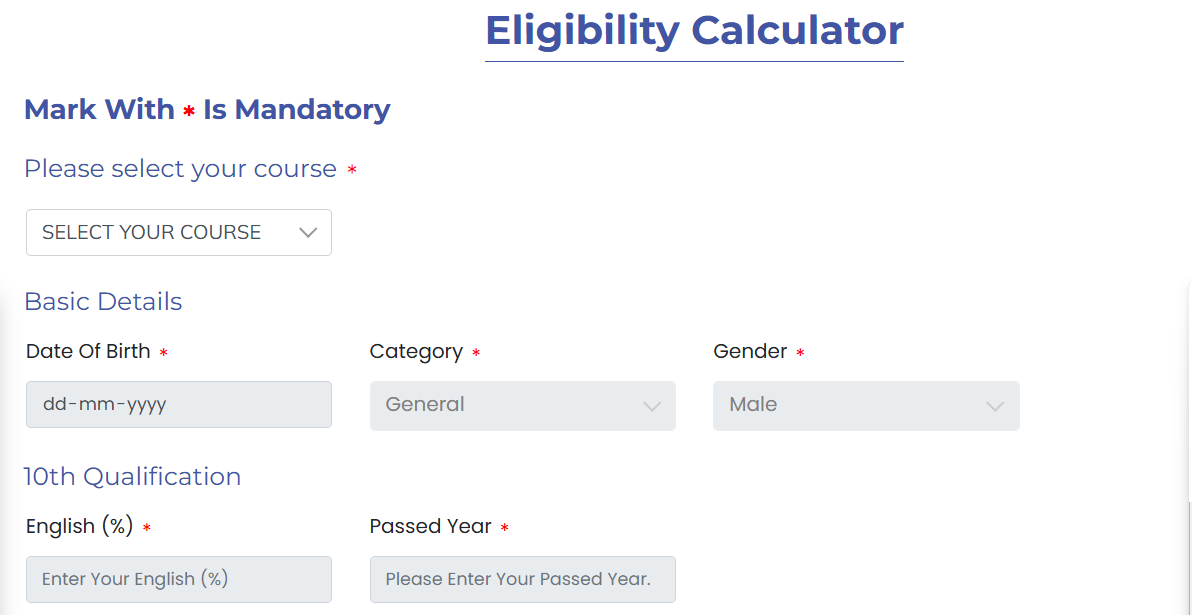
If you are unsure whether your Class 12 marks, age, or other details meet the requirements, the Eligibility Calculator can help you check your eligibility for relevant courses and colleges. It is a useful starting point before preparing for the entrance examination.
Marine Engineering Admission Through IMU-CET
IMU CET is the most important entrance examination for admission to marine engineering courses in India. The examination is conducted by IMU for admission to its undergraduate courses and affiliated institutions. As per the IMU prospectus for the year 2026-27, qualification in IMU CET is mandatory for admission to the approved B.Tech. Marine Engineering course.
Admission procedure usually involves the following steps:
Step 1: Register for IMU-CET
The first step is to register for IMU-CET through the official IMU admission portal.
Students should visit the official website:
The registration process generally includes:
- Creating an account on the admission portal.
- Filling in personal and academic details.
- Selecting the relevant examination or program.
- Uploading the required documents.
- Paying the application fee.
- Submitting the application.
Careful attention to their name, date of birth, category, and educational information is advised before submitting the form. The fee for the undergraduate courses for the 2026 examination was ₹1,200 for the general category candidates and ₹800 for the SC/ST candidates. Fees may vary for future admission cycles.
Step 2: Prepare for the IMU-CET Examination
IMU-CET is an important part of the marine engineering admission process.
The undergraduate examination covers subjects such as:
- Physics
- Chemistry
- Mathematics
- English
- General Aptitude
The pattern of the examination, no. of questions asked, marking scheme, and syllabus need to be studied in detail in the official notification of that year. IMU-CET aspirants must concentrate on the concepts covered in Class 11 & Class 12, specifically in subjects like physics, chemistry, and mathematics.
Practice through the old question papers and sample test series will definitely help students in knowing the pattern of the examination.
Prepare With the Crack IMUCET Book
Apart from that, another book that may serve the purpose of structured preparation is the Crack IMUCET Book. This book can be used in conjunction with other study material. The advantage of having a preparation book is that one does not have to search for practice material from other sources, as everything is consolidated in one place.
Step 3: Appear for IMU-CET
After registration is done, the candidate will download the admit card and attend the exam on the assigned date. The students need to adhere to the rules and regulations of the exam. The results are published by IMU after the exam and the ranks of the students.
Step 4: Check Your IMU-CET Rank
After the declaration of the results, the candidates will have to download the certificate of their ranks and analyze their performance. The rank is crucial since it determines the admission prospects during the counseling session. Better ranks increase the possibility of securing the desired campus or program, depending upon seat availability and preferences submitted. But just qualifying for IMU-CET does not mean admission. The candidates need to fulfill the academic eligibility criteria and other admission formalities as well.
Marine Engineering Counseling and College Selection
After qualifying for IMU-CET, students must complete the admission process according to the type of institute they want to join.
There are two main routes.
Admission to IMU Campuses
For admission to IMU campuses, candidates must register for online counseling.
The general procedure includes:
- Registering for counseling.
- Paying the applicable counseling fee.
- Filling in college and program preferences.
- Participating in the seat-allotment process.
- Confirming the allotted seat.
- Completing document verification.
IMU publishes admission lists and counseling notifications through its official website.
Students should check the seat matrix and available programs before filling in their preferences.
Admission to Affiliated Institutes
Students applying to IMU-affiliated institutes generally need to follow the admission process announced by the respective institute.
The process may include:
- Submitting the IMU-CET rank certificate
- Completing the institute’s application form
- Attending an interview or assessment, if required
- Completing document verification
- Paying the applicable admission fees
The exact process can differ from one institute to another. Candidates should also verify whether the institute and its marine engineering program have the required approvals.
Documents Required for Marine Engineering Admission
Students should keep their documents ready before counseling or institute-level admission.
The commonly required documents include:
- Class 10 marksheet and certificate
- Class 12 marksheet and certificate
- IMU-CET rank certificate
- IMU-CET admit card, if required
- Government-issued photo identification
- Passport-size photographs
- Category certificate, if applicable
- Medical fitness certificate
- Passport, if available or required
- Admission and fee payment receipts
Some institutes may ask for additional documents.
Students should keep scanned copies of their documents for online applications and original documents for verification.
Merchant Navy Decoded App: Keep Track of Admission Updates
Marine Engineering admission involves several important dates, including entrance examination registration, counseling, college applications, and admission deadlines. Missing an important deadline can affect your admission plans.
The Merchant Navy Decoded app can be useful for students who want to follow maritime course updates and admission-related information in one place. Its resources include course guidance and updates for aspiring Merchant Navy candidates. Students can use the app alongside official IMU notifications to keep track of the admission process and stay informed about relevant opportunities.
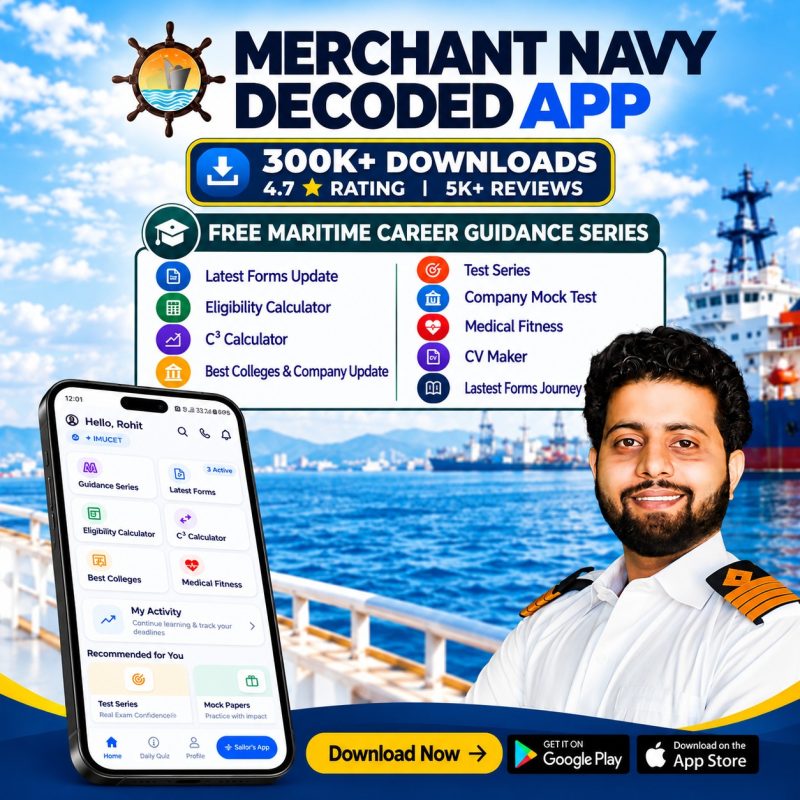

Table of Contents
Medical Examination and Final Admission
Once a seat is allocated to the candidate, he or she needs to fulfill the medical and document verifications set forth by the institute. The aspect of medical fitness is especially crucial since marine engineering requires working in harsh shipboard conditions. The candidate must ensure that his or her medical examination is carried out by the right medical examiner.
Students should also confirm:
- Whether the course is approved by the Directorate General of Shipping (DG Shipping).
- Whether the institute has approval for the relevant academic year.
- Whether the allotted seat is confirmed.
- Whether all fees and documents have been submitted.
Admission is considered complete only after the candidate fulfills the institute’s requirements and receives confirmation.
How to Choose the Right Marine Engineering College
Choosing a college is an important decision because the quality of training and facilities can affect a student’s preparation for a career at sea.
Students should compare colleges based on the following factors.
1. Approval and Affiliation
Check whether the institute and its Marine Engineering program have the necessary approvals. Students should not rely only on advertisements or promotional claims.
2. Training Facilities
Marine Engineering requires practical knowledge of machinery and ship systems. Look for institutes with suitable workshops, laboratories, simulators, and training equipment.
3. Placement and Career Support
Check the institute’s placement record and the companies that recruit its graduates. Students should understand the difference between a placement opportunity and a guaranteed job.
4. Total Course Fees
Compare the complete cost of the program, including tuition, hostel, mess, uniforms, training expenses, and other charges. A college with lower tuition fees may still have a higher overall cost.
5. Location and Campus Facilities
Students should also consider hostel facilities, campus discipline, food, transportation, and the overall learning environment.
Marine Engineering Admission Through Lateral Entry
Other than the normal admission process post Class 12, there are lateral entry possibilities at IMU for eligible diploma or engineering students. Lateral entry means that eligible candidates will be admitted to the second year of the B.Tech. Marine Engineering program as per the qualifications and availability of seats.
The admissions for lateral entry at IMU campuses as per IMU circular 2026, are done on the basis of marks secured in the qualifying diploma/degree as well as merit. However, IMU-CET is not necessary for lateral entry as per this circular. Eligibility criteria and qualifications may vary.
Conclusion
The admission procedure for marine engineering consists of certain steps, including verification of eligibility and registration in IMU-CET. Students will be required to have the eligibility criteria, secure a proper rank, go through counseling or admission at the institute level, and satisfy the necessary medical criteria.
The most important aspect is that students should verify the admission criteria of the academic year before applying. Proper preparation and planning will help students make wise decisions regarding marine engineering studies and careers.

FAQ’s (Frequently asked Questions)
Students appearing for Class 12 may generally apply for IMU-CET, subject to the admission notification. However, they must meet the final academic eligibility requirements and submit the required marksheets before admission.
The option to modify college preferences depends on the counseling schedule and rules announced by IMU. Students should check the official counseling portal for editing deadlines and instructions.
Yes. Students can apply to multiple eligible institutes, provided they meet each institute’s admission conditions and complete the required application and entrance processes.
IMU-CET is the common entrance examination for relevant IMU and DGS-approved marine engineering admissions. Some institutes may conduct additional selection procedures, so candidates should check the individual institute’s admission notice.
A student may be able to apply for the entrance examination while awaiting the result, depending on the current rules. However, the student must pass the qualifying examination and meet all eligibility requirements before admission.
Yes. Students can explore multiple eligible colleges. However, the application process, counseling requirements, and admission deadlines may differ between institutes.
No. A good rank can improve admission opportunities, but it does not guarantee employment. Career opportunities depend on completing the course, meeting medical and certification requirements, and securing suitable employment.
Candidates must meet the subject requirements specified in the applicable admission prospectus. Students with equivalent qualifications should confirm whether their board and subjects are accepted before applying.