AMET B.Sc. Nautical Science Eligibility Criteria
Selecting the right course is the first step towards making a career in the Merchant Navy. For those who want to become navigational officers and are considering joining B.Sc. Nautical Science at AMET University, knowing the eligibility requirements is vital before applying to the course.
Located in Chennai, AMET University conducts a three-year B.Sc. Nautical Science course through its Department of Nautical Science. But just having Class 12 marks is not enough for joining the course. One has to satisfy other conditions such as English, age, medical, and entrance examination requirements.
Here, we have explained each eligibility criterion one by one, such as minimum PCM percentage, English marks, age limit, category-wise relaxation, eyesight requirement, passport, and AMET’s admission process. We have also discussed how to prepare for the entrance examinations and verify your eligibility for joining the course.
About B.Sc. Nautical Science at AMET University
The B.Sc. Nautical Science course in AMET is meant for candidates interested in joining the deck department of the Merchant Navy. The course includes topics such as navigation, ship handling, seamanship, cargo operations, stability of ships, and many more related to working in a merchant vessel.
As per the official information of AMET regarding the program:
- Course: B.Sc. Nautical Science
- Duration: 3 years
- Number of Semesters: 6
- Nature of program: Residential program
- Qualification needed: Class 12th with physics, chemistry, and mathematics and prescribed marks in English
- Medical fitness: Necessary as per the requirements of the course
- Boys and girls both can apply for the course.
Students should verify the course details and admission intake as per the current year from the AMET website before applying.
AMET B.Sc. Nautical Science Eligibility Criteria
To apply for a B.Sc. in Nautical Science at AMET, candidates must satisfy the academic, age, medical, and other admission requirements.
1. Educational Qualification: Class 12 with PCM
The applicant is expected to have a Class 12 pass out from a recognized board or any equivalent exam.
The following subjects should be taken:
- Physics
- Chemistry
- Math
- English
Physics, chemistry, and math should be taken as individual subjects. Candidates who have done PCB without math from Class 12 are not eligible for this course. Class 10 and Class 12 from a recognized board, as per the official eligibility criteria of the AMET program.
Why is PCM required?
The discipline of nautical science has some technical and mathematical aspects. Navigation, ship stability, mathematics, meteorology, and various other topics need a proper knowledge of physics and mathematics. Hence, PCM becomes an essential prerequisite for any student aspiring to join the deck department.
2. Minimum PCM Percentage: 60%
The most important criteria for admission to AMET B.Sc. Nautical science is the PCM percentage. Candidates are required to have an average PCM percentage of 60% in Class 12th. PCM is the percentage of the three subjects: physics, chemistry, and mathematics, and not the overall percentage of Class 12th.
Relaxation for SC/ST candidates
The AMET published program eligibility criteria offer a 5% concession on the PCM eligibility scores of SC/ST applicants. This concession pertains to the PCM requirement. This concession is not applicable in reducing the English requirement. Applicants seeking this concession are advised to refer to the current admission prospectus.
3. English Marks: Minimum 50%
Besides having a PCM score, it is mandatory for the candidates to have scored a minimum of 50% marks in English in class 10 or class 12. It is another separate eligibility criterion altogether.
For instance:
- A candidate who has scored 65% PCM and 55% in English in class 10 has fulfilled both the criteria.
- Whereas a candidate who has scored 70% PCM but only 45% in English in class 10 and class 12 cannot fulfill the English criterion.
Hence, do not just check your PCM percentage; make sure that you have also met the criterion for English.
Special English relaxation
The program information published by AMET states that there is a relaxation of 5% in the marks of English for a particular set of candidates who are:
- Natives of the Lakshadweep or Andaman and Nicobar Islands.
- Scheduled Tribes of these islands.
- Both the parents are natives of these islands and belong to the Scheduled Tribes of these islands.
This is a relaxation that comes under certain conditions and should not be misconstrued as English relaxation for all SC/ST candidates.
4. Age Limit
Age is another important condition for B.Sc. Nautical Science admission. AMET’s published program information specifies that candidates must be below 25 years of age at the time of commencement of the program.
The same program information mentions the following age relaxations:
Category | Published age relaxation |
General category | No additional relaxation |
SC/ST candidates | 5 years |
OBC candidates | 3 years |
Women candidates | Additional 2 years for each category |
These are the exemptions as specified in the program page of AMET. Since the age restrictions can always be amended and interpreted using the admission prospectus of a specific intake, the applicants must first check the relevant age computation and supporting document from AMET.
Want to check whether you are eligible for AMET or how far you are eligible for the maritime field, then, check Your Eligibility with the Merchant Navy Decoded App eligibility calculator.
Make sure to consider all the criteria for eligibility before filling out the application form. The Eligibility Calculator within the Merchant Navy Decoded app allows you to assess yourself for academic eligibility.
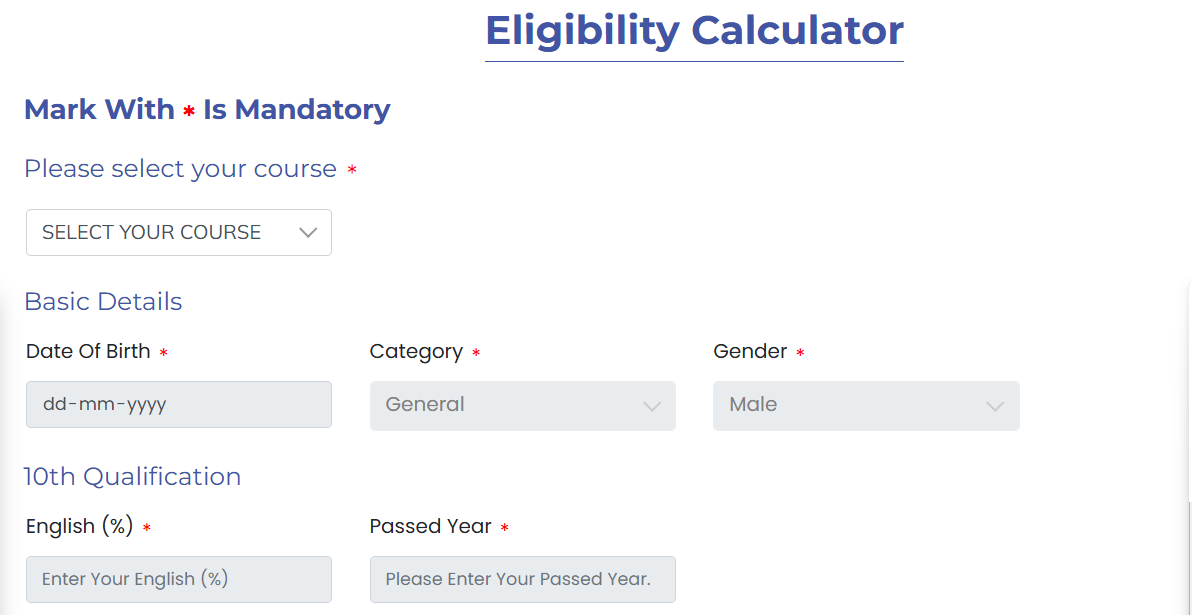
It can be used to check on basic eligibility criteria, but it does not constitute any sort of admission decision or replacement of verification by AMET. The app also includes maritime advisory resources, college info, counseling by experts, medical fitness information, forms, and other information from DG Shipping.
5. Medical Fitness
Fitness for medical purposes is among the most crucial criteria for B.Sc. Nautical Science. While other bachelor’s programs do not require students to take on an occupation in the maritime industry, Nautical Science trains its students to become professionals in the field.
According to AMET, it is essential for candidates to be fit to go to sea, as well as satisfy the necessary medical requirements of the Directorate General of Shipping. These medical requirements are related to vision, color blindness, hearing, and general physical fitness.
Eyesight requirement
In the case of candidates to the deck department, the pre-sea eyesight requirements set by DGS state:
- Distance vision 6/6 in the better eye without aid.
- Distance vision 6/9 in the other eye without aid.
- Good color vision as confirmed with the Ishihara test chart.
These are the published DGS pre-sea eyesight standards for the nautical department.
Color vision
Good color vision is important while working at deck level since mariners have to see the color of navigation lights and other colored signals. You can check your color vision in the Merchant Navy Decoded App, which has designed a separate test for color vision.
The other features of the app include
- IMU-CET & Sponsorship Guidance: Helps aspirants understand IMU-CET preparation, sponsorship opportunities, and the Merchant Navy admission process.
- Eligibility Calculator: Helps students make an initial assessment of their eligibility for Merchant Navy courses.
- College Portal: Provides information about maritime colleges and available courses to help aspirants explore their options.
- Expert Counselling: Guides students in choosing suitable courses and understanding admission and career pathways.
- Test Series & Mock Tests: Helps aspirants practice exam-style questions and improve their preparation for IMU-CET.
- Medical Fitness Calculator: Helps students assess their medical fitness against relevant Merchant Navy requirements.
General medical examination
The medical officer also checks the physical suitability of the candidate to serve at sea. A candidate will have to secure a medical fitness certificate from a doctor approved by the Directorate General of Shipping. One should not take it for granted that fulfilling the academic eligibility criteria assures medical suitability. It would be prudent to know the medical criteria before joining the course.
6. Passport Requirement
According to AMET, the details on the eligibility criteria for the B.Sc. Nautical Science course clearly specify that a passport is compulsory. The reason behind this requirement is that as a professional in the Merchant Navy, one’s work might require him/her to undertake foreign trips and join ships plying in different nations.
For this reason, students need to refer to the current document list provided by the university for the submission of the passport. It is recommended that students do not wait till the last minute to prepare the passport documents.
7. Entrance Examination Requirement
However, meeting the academic qualifications is not a guarantee that one will be admitted. AMET has its own admission criteria for the undergraduate courses, and information provided by AMET also includes examination requirements for the B.Sc. Nautical Science.
There are two key issues to consider.
AMET Common Entrance Test (AMETCET)
According to AMET’s information regarding admissions, the ranking list of the qualifying examination and entrance examination determines the selection of the candidates in the undergraduate program.
On the admissions page of the university, AMETCET information is also provided for its maritime programs.
AMET B.Sc. Nautical Science Admission Process
Once they verify their eligibility criteria, students should be aware of the admissions process.
As per the admission process details provided by AMET, there are the following general steps involved:
- Application: Candidates apply to the admissions process via the online AMET Admission Portal.
- Scrutiny of Eligibility: The university verifies the qualifications of the candidate along with the eligibility documents.
- Entrance exam and selection: Candidates are evaluated through the entrance exam and respective selection process.
- Rank List: The rank list is made as per the selection criteria.
- Medical Test: Selected candidates have to undertake the medical test arranged by doctors authorized by DGS.
- Counseling & Verification: Eligible candidates go through the counseling and verification process of the university.
- Admission: The selected candidates get the admission procedures along with the relevant formalities to be completed within the given period.
Dates, procedure of applications, exams, fee payment, and all such other details can vary for each admission process. Always go for the current AMET Notification instead of using an outdated admission process.
Table of Contents
How to Prepare for AMET B.Sc. Nautical Science Admission
After the verification of eligibility criteria, you need to prepare for the entrance examination. A proper preparation strategy will assist you in revising the necessary subject areas, developing problem-solving skills, and getting acquainted with time-bound tests.
Academic Preparation
Make sure you have a solid base in:
- Physics
- Chemistry
- Mathematics
- English
Always concentrate on concept building and regular practice of questions. Do not rely on memorization at all, especially in physics and mathematics.
Prepare with JMDI Academy
For those who like structured preparation, there is always the option of the one-year IMU-CET and Sponsorship Preparation Programme provided by JMDI Academy.
This includes subjects such as PCM, English and aptitude, with frequent testing and practice interviews, communication, and mentoring too. Structured study can allow students to prepare on a regular basis rather than try to cover the whole syllabus near the examination. It is recommended that you go through the present program information, teaching timings, and syllabus content before enrolling.
Practise with the Crack IMUCET Book.
Practicing questions for entrance examinations is as crucial as mastering the theory.
Crack IMUCET Book is one such resource, which offers:
- Over 6,000 Chapter-wise Multiple Choice Questions (MCQs).
- Compact Theory for revision.
- Detailed solutions to questions.
- Analysis of previous year’s questions.
- Five complete mock tests.
The students can make use of this book for revising topics individually, solving questions, and finding areas that need more work. An effective method would be to study a particular topic, solve its MCQs, analyze the wrong questions, and then move on to the next topic.
Practice Through Test Series and Mock Tests
Mock tests on a regular basis will make you accustomed to exam conditions as well as your time management skills. Instead of just verifying the marks after taking a test, try to analyze where your mistakes lie; that is, check whether you committed a mistake due to your understanding or due to insufficient time.
The test series of the Merchant Navy Decoded may be considered an extra option for the students preparing for IMU-CET and other maritime entrance exams.
However, you should verify the test series details and syllabus before taking this into consideration.
Important Points to Check Before Applying
Prior to sending your application to AMET, you need to check the following:
- Have you cleared Class 12 in physics, chemistry, and mathematics?
- Does your PCM aggregate score stand above 60%, or do you qualify for the relevant relaxation?
- Are you able to secure 50% aggregate in English either in Class 10 or Class 12, or are you eligible for island-ST relaxation?
- Do you fulfill the age criteria along with the required category relaxation?
- Do you possess the passport compulsorily?
- Are you eligible to meet the criteria for the medical fitness and eyesight set by the DGS?
- Have you gone through the latest admission eligibility criteria of AMETCET & IMU-CET?
- Have you studied the latest prospectus & admission calendar?
Checking these criteria before the application will help you not get confused.
Final Verdict
AMET’s B.Sc. Nautical Science course is one of the ways available to students interested in the deck-officer route within the Merchant Navy. It is advisable that all the eligibility criteria be studied by any prospective candidate and not merely the PCM percentage in Class 12.
Some of the important eligibility criteria mentioned by AMET are a PCM percentage of 60%, an English percentage of 50% in either class 10 or 12, the stipulated age limit, medical fitness, and a passport. Moreover, it is crucial for all the candidates to know about AMET’s entrance-examination procedure and selection process.
In case you are planning to apply for AMET’s program, first verify the eligibility criteria for academics, medical fitness, and entrance examinations for the respective year from AMET’s end. Post verification of the eligibility criteria, follow a systematic approach towards the preparation of required examinations.
JMDI Academy, Crack IMUCET Book, and Merchant Navy Decoded App’s resources will prove helpful in your preparation for the AMET exams.
FAQ’s (Frequently asked Questions)
A minimum average of 60% marks in physics, chemistry, and mathematics in Class XII is required. There is 5% relaxation on PCM eligibility marks for SC/ST students as per the program information published by AMET.
Yes. The candidate should have passed in English with a minimum of 50% marks in class 10th or class 12th. There is a certain relaxation provided to the eligible ST candidate from Lakshadweep and the Andaman and Nicobar Islands.
The published eligibility criteria for the subject combination demand physics, chemistry, and mathematics as distinct subjects. A student who did PCB without mathematics cannot proceed with the course.
According to AMET’s website for the program page, the candidate must not exceed 25 years of age at the start of the program. The program page also refers to age relaxation for the candidates falling in the category of SC/ST, OBC, and female candidates.
Not fulfilling the eligibility criteria would make the candidate ineligible for consideration. Admission will depend on the university’s admission procedures, entrance exam eligibility, physical fitness, document verification, and availability of seats.
Yes. The AMETCET is the entrance test for AMET, whereas IMU-CET is conducted by the Indian Maritime University. The admission details of AMET include the shortlist procedure of AMET along with IMU-CET or any other entrance test.
Yes. AMET’s published B.Sc. Nautical Science program brochure says that a passport is mandatory. Please check out the current admission documents list.
DGS pre-sea eyesight requirements for the nautical department include 6/6 distant vision in the better eye and 6/9 distant vision in the worse eye. In addition, candidates should have normal color vision, as tested by the Ishihara chart.
Yes. According to the program information of AMET, both boys and girls can apply for admission. The applicants should meet the academic, medical, and published age requirements as well.
The program lasts for three years and comprises six semesters. It is referred to as a residential program by AMET.
