
How to Become a Marine Engineer

If you like engineering, machines, ships, and the thought of working in an international industry, then becoming a marine engineer can be an interesting career choice. Marine engineers are responsible for the machinery that keeps a ship moving and working, including propulsion systems, generators, pumps, boilers, and other vital equipment.
B. Tech courses for Class 12 students who want to join the Merchant Navy. Technology in marine engineering is a direct approach to the engine department.
But getting the degree is just the beginning. After college, you need to do onboard training, practical sea experience, and Certificates of Competency before you work your way up through the ranks to become a Chief Engineer. Let’s understand the complete journey step by step.
B.Tech. Marine Engineering: The Main Route After 12th
Admission to B.Tech. Marine Engineering generally requires qualifying for the IMUCET (Indian Maritime University Common Entrance Test). Students should check the latest IMU admission notification for the current eligibility criteria, application dates, and examination requirements.
B.Tech. in Marine Engineering is generally a four-year undergraduate program designed to prepare students for careers as marine engineering officers.
The program combines conventional engineering fundamentals with specialized marine subjects. Indian Maritime University describes its B.Tech. Marine Engineering program as a residential four-year course covering areas such as marine machinery systems, turbo machinery, internal combustion engines, boilers, naval architecture, steam plants, and marine simulators.
The course is designed around the knowledge and practical competencies required for work onboard ships under international maritime training standards.
After completing the required academic and practical training, students can begin their professional journey toward working as marine engineer officers onboard merchant ships.
Eligibility for B.Tech. Marine Engineering
The exact admission requirements can vary between institutes, so students should always check the current requirements of the college they want to join. For a detailed overview of B.Tech. Marine Engineering eligibility, colleges, fees, and admission information, students can also check the B.Tech. Marine Engineering guide.
For the B.Tech. Marine Engineering program at IMU, the current basic academic requirements include:
- Passed 10+2 or equivalent examination
- Physics, Chemistry, and Mathematics (PCM) as mandatory subjects
- Minimum 60% aggregate in PCM
- Minimum 50% in English in the 10+2 examination
- Must meet the required medical fitness standards for sea service
IMU also gives 5% relaxation in PCM marks for SC/ST candidates, and the English requirement is taken separately.
Medical fitness is particularly important since marine engineers work in a demanding shipboard environment. Candidates need to have their medical examination done by a doctor approved for the relevant maritime medical examination before making any major decisions about the course.
Admission requirements can vary from college to college, so don’t assume if you qualify for one college, then you will qualify for every B.Tech Marine Engineering Laboratory.
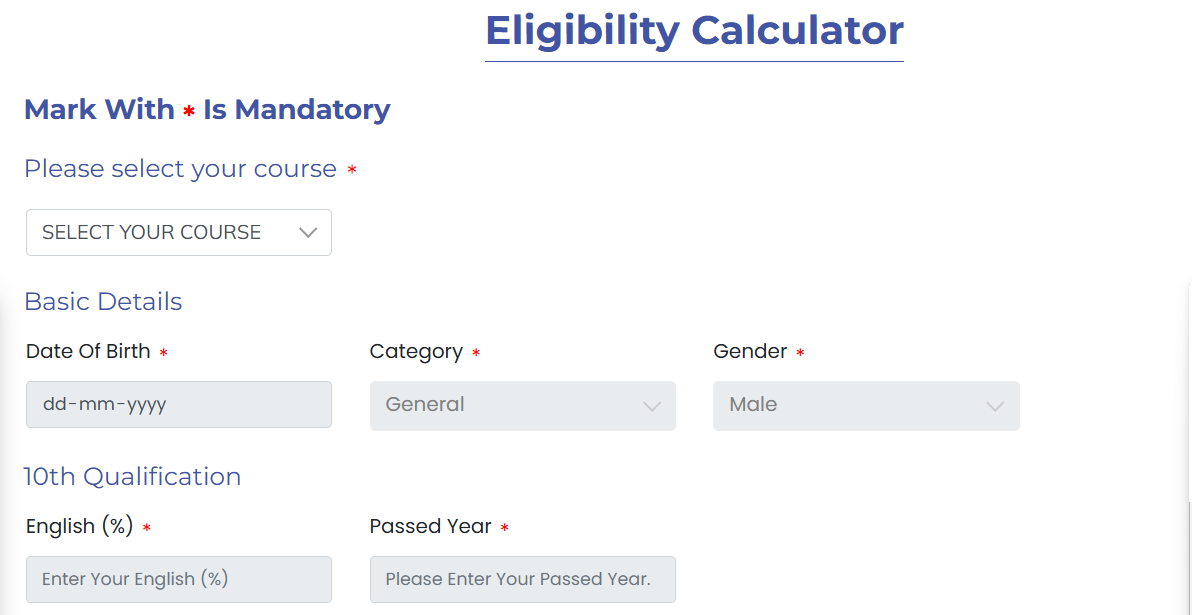
You can check your eligibility criteria for different marine engineering colleges and companies using the eligibility calculator.
What Do You Study in B.Tech. Marine Engineering?
One of the interesting things about this course is that it starts with engineering fundamentals and gradually moves toward specialized ship machinery.
During the four years, students generally study subjects covering areas such as
Engineering Fundamentals
In the beginning, students build their foundation through subjects such as
- Engineering Mathematics
- Engineering Physics
- Engineering Chemistry
- Engineering Drawing
- Basic Electrical Engineering
- Basic Electronics
- Engineering Mechanics
- Thermodynamics
- Fluid Mechanics
- Material Science
These subjects may look similar to those taught in other engineering programs, but they provide the foundation required for understanding complex marine machinery.
Marine Engineering Subjects
As students progress, the curriculum becomes more specialized.
Major areas include:
- Marine Diesel Engines
- Marine Boilers
- Marine Steam Engineering
- Marine Turbo Machinery
- Marine Machinery Systems
- Marine Auxiliary Machinery
- Naval Architecture
- Marine Electrical Systems
- Refrigeration and Air Conditioning
- Ship Construction
- Marine Pollution Prevention
- Automation and Control Systems
- Marine Machinery Design
- Engine Room Simulator
IMU specifically highlights marine internal combustion engines, marine boilers, turbo machinery, steam plants, machinery systems, naval architecture, and simulator-based learning in its B.Tech. Marine Engineering curriculum.
Students also spend time in laboratories and workshops. This practical exposure is important because working onboard is not just about knowing how an engine works from a textbook. You need to understand how to inspect, operate, maintain, and troubleshoot actual equipment.
What Does a Marine Engineer Do?
A marine engineer is primarily employed in the engine department of the ship. The deck department deals with navigation, cargo operations, and general movement of the vessel, while marine engineers are responsible for the technical systems that make a vessel work.
Their responsibilities can include:
- Operating and maintaining the main propulsion engine
- Maintaining generators and auxiliary machinery
- Monitoring fuel, cooling, lubrication, and other systems
- Carrying out planned maintenance
- Troubleshooting machinery problems
- Maintaining engine-room records
- Following safety and environmental procedures
- Working with other members of the engineering team
As an engineer gains experience and moves up the ranks, the level of technical and managerial responsibility also increases.
What Happens After B.Tech. Marine Engineering?
Here is where the career differs from a typical engineering degree. Once you’ve finished your shore-based education and training, then you move into onboard sea training. The aim is to gain practical experience and to fulfill the sea service required for the relevant Certificate of Competency.
Depending upon the institute and training arrangement, a graduate may join a vessel in a trainee capacity, such as Trainee Marine Engineer or Engine Cadet, working under experienced engineers.
The Directorate General of Shipping has also prescribed the requirements relating to qualifying sea service for engineering officers desirous of obtaining Certificates of Competency.
Table of Contents
What Is Done During Onboard Training?
Onboard training is where the theory learned in college starts making practical sense.
As a trainee, you work under the supervision of senior engineering officers rather than independently handling critical machinery.
Your training can involve learning about:
- Main engine operation
- Diesel generators
- Pumps and compressors
- Boilers and steam systems
- Fuel and lubrication systems
- Cooling-water systems
- Engine-room safety
- Planned maintenance
- Machinery inspections
- Troubleshooting procedures
- Engine-room watchkeeping
- Pollution-prevention procedures
- Emergency procedures
- Maintenance documentation
Trainees also become familiar with the ship’s machinery arrangement, operating procedures, safety systems, and maintenance practices. The training is not simply about watching senior engineers work. Trainees gradually take on practical responsibilities under supervision while recording their training and sea service as required.
DG Shipping documentation requirements include records such as the CDC/logbook, Training and Assessment Record (TAR) Book, sea-service testimonials, and relevant STCW certificates for certification processes.
From Trainee to 4th Engineer
The next big step after completing the necessary training, sea service, courses, assessments, and examinations is to get the MEO Class IV Certificate of Competency.
The certification is linked to the role of engineering officer of the watch and allows the engineer to move up into the officer ranks.
The MEO Class IV is a preliminary requirement for entry into the profession as a fourth engineer, after compulsory onboard training and examinations. Here the career takes an abrupt turn. You’re no longer a trainee; you’re an engineering officer with watchkeeping duties.
Marine Engineer Promotion Flow
The engine department follows a structured hierarchy. A simplified career progression is
Trainee Marine Engineer → 4th Engineer → 3rd Engineer → 2nd Engineer → Chief Engineer
The exact sea-service requirements and certification conditions must be checked against the current DG Shipping rules and applicable regulations.
4th Engineer
The 4th Engineer is usually the entry-level officer rank in the engine department after earning the required Class IV certification. The engineer is under orders from the senior officers and attends to the machinery assigned to him, watchkeeping, maintenance, and such other engine-room duties.
This phase is about gaining actual shipboard experience and becoming comfortable with machinery and engineering operations.
3rd Engineer
With further sea service and experience, an engineer can progress to the 3rd Engineer rank.
The 3rd Engineer takes on greater responsibility for machinery and maintenance and continues to develop the practical and managerial skills needed for higher ranks.
2nd Engineer
The next big step is to become a 2nd engineer. This is a senior engineer position. The 2nd Engineer is deeply involved in the day-to-day management of the engine department, maintenance planning, machinery operations, and supervision of junior engineers and ratings.
The MEO Class II Certificate of Competency is the certificate that qualifies you to serve as second engineer after you have done the required sea service and training.
Chief Engineer
The head of the engine department is the chief engineer. The chief engineer is responsible for the operation of the ship’s machinery and technical services. This includes propulsion machinery, generators, auxiliary systems, maintenance, safety, and supervision of the engineering team.
The top rank in the ship’s engine department is the chief engineer, who needs technical knowledge, leadership, and a lot of sea experience. Getting to this level requires the right experience, training, assessments, and an MEO Class I Certificate of Competency.
So, you don’t become a chief engineer right out of B. Technology. It is the result of years of education, in-service experience, examinations, and continuing professional development.
What Happens After Becoming a Chief Engineer?
Becoming a chief engineer does not necessarily mean you have to spend your entire career at sea.
One of the advantages of a marine engineering background is that the skills developed onboard can also be useful for shore-based maritime careers.
Experienced marine engineers can explore roles such as
- Technical Superintendent
- Fleet Management
- Ship Management
- Marine Surveyor
- Port and maritime organizations
- Marine equipment companies
- Shipyards
- Maritime training institutes
- Classification and inspection-related roles
- Maritime safety and compliance
- Technical management
- Marine consultancy
- Shipping company management
For example, DG Shipping’s administrative structure includes technical superintendent and engineering surveyor positions, which require suitable engineering qualifications, certificates of competency, and relevant sea experience.
This is one reason why a career in marine engineering can be a step above life at sea. Eventually, your shipboard experience can prove valuable in technical management, inspections, training, ship operations, and other shore-based positions.
How Long Does It Take to Become a Chief Engineer?
There is no single fixed timeline that applies identically to every engineer.
Your progression depends on factors such as
- Completion of required sea service
- Passing competency examinations
- Completing mandatory training
- Availability of suitable shipboard positions
- Performance and experience
- Meeting current regulatory requirements
The important thing is to look at a career in marine engineering as a long-term process and not a four-year college course.
B. Technology is the academic background you get. Training on board helps you to gain practical experience. With Certificates of Competency, you can rise through the officer ranks.
Is B.Tech. Marine Engineering a Good Career Choice?
A B.Tech. in Marine Engineering can be a strong option for students who genuinely enjoy engineering and are comfortable with the lifestyle associated with working at sea.
It offers:
- A specialized engineering career
- Practical exposure to large machinery
- International work opportunities
- A structured promotion system
- Opportunities to move into shore-based roles later
- The possibility of progressing to senior management positions onboard
At the same time, students should be aware that life onboard is different from normal engineering jobs. You may be away for long periods, work shifts, and have a lot of responsibility for machinery and safety.
So don’t go for the course just because you heard about the salary. If you’re interested in engineering and can see yourself adapting to shipboard life, do it.
Prepare Smartly With the Merchant Navy Decoded App
Choosing the right college and keeping track of admission opportunities can be confusing, especially when you are applying to several maritime programs.
The Merchant Navy Decoded app can make the early part of your preparation more organized.
The Merchant Navy Decoded app offers a dedicated test series that helps you practice relevant questions, improve your speed, and get familiar with the exam pattern.
Prepare with the Crack IMUCET Book
Use dedicated preparation material for IMUCET preparation, using the Crack IMUCET Book.
Instead of searching through multiple websites every time a new form or admission update appears, having these tools together can make your preparation much easier.

FAQ’s (Frequently asked Questions)
No. Marine engineering covers much more than the main engine. Engineers work with generators, pumps, boilers, compressors, electrical systems, automation, refrigeration, fuel systems, and many other technical systems onboard.
Yes. Marine engineering knowledge can be useful in shipyards and companies involved in ship construction, machinery installation, testing, commissioning, and maintenance.
No. Marine engineers can work on different types of commercial vessels, depending on their qualifications, training, experience, and the requirements of the employer.
Yes. The engineering knowledge and practical experience can be useful for several maritime and engineering-related shore careers, although specific positions may require additional qualifications or experience.
Both fields share engineering fundamentals, but marine engineering specifically focuses on machinery and systems used in ships and other marine vessels. A mechanical engineer has a broader field of applications across industries.
Yes. Modern ships depend heavily on electrical equipment, automation, control systems, and power generation. Marine engineers therefore need knowledge of electrical and electronic systems as part of their training.
Yes. Engineers can pursue relevant postgraduate education and professional training depending on their career goals. For example, IMU offers postgraduate programs in areas including marine technology, marine engineering, and management.