How to Get Admission in BSc Nautical Science

BSc in Nautical Science is a three-year undergraduate program for students who want a career in the deck department of the Merchant Navy. The program deals with subjects like navigation, seamanship, ship work, cargo management, maritime laws, and ship stability.

For students from a science background, a BSc in Nautical Science is an easy way to enter the maritime industry after finishing Class 12. However, admission to this course is not just the process of filling out the college form. Students must satisfy specific academic and medical requirements, take the entrance examination, and follow the process of admission to the institute of their choice.

This process can vary among different colleges. Hence, it is advisable to have a good understanding of the admission process.

What Is BSc Nautical Science?

Students receive instruction in navigation, ship stability, implications of cargo operation, maritime law, meteorology, maritime communication, and seamanship, among other important subjects relating to ship operations. The program qualifies graduates for a career as a deck officer after fulfilling required theoretical learning and practical training.

The BSc Nautical Science program offered by the Indian Maritime University (IMU) is a three-year residential course provided at all IMU campuses and other approved maritime institutes.

Who Can Apply for BSc Nautical Science?

 The first step is to check whether you meet the eligibility requirements.

For the 2026-27 academic session, IMU’s eligibility requirements for BSc Nautical Science include:

  • Passing Class 12 or an equivalent examination.
  • Physics, Chemistry, and Mathematics (PCM) must be studied in Class 12.
  • Minimum 60% average marks in PCM.
  • Minimum 50% marks in English in either Class 10 or Class 12.
  • The candidate must be unmarried.
  • A valid IMU-CET rank is required.
  • The candidate must satisfy the prescribed medical fitness requirements.

The age limitation is also relevant. From 2026-27, the IMU set a maximum age of 25 for male candidates in the general category, with further relaxations for some categories and candidates of the female gender. The exact age rules should always be checked against the prospectus for the admission year in which you apply.

There can be other prerequisites as well. For instance, Tolani Maritime Institute requires passing not only the IMU-CET but also other types of selection, including its own online testing.

Thus, fulfilling the minimum requirements does not mean that you will be accepted into one of the BSc Nautical Science colleges.

Step 1: Check Your Eligibility Before Applying
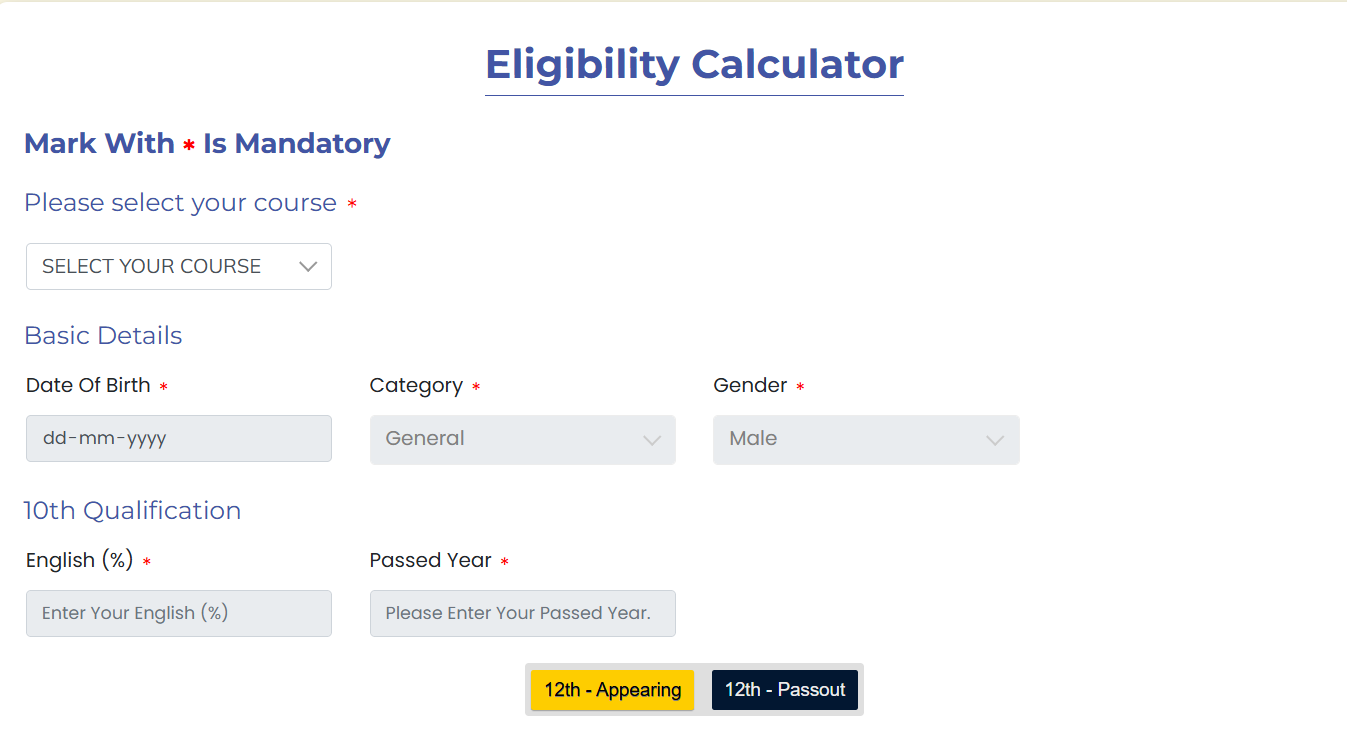
Eligibility calculator

Not sure which colleges or courses you can apply for? The eligibility calculator allows students to check their eligibility based on their academic details and other requirements. This can save time before applying to different colleges.

Step 2: Apply for IMU-CET

IMU CET is a very important part of the admission process for BSc Nautical Science.

“Admission to BSc Nautical Science is done through IMU-CET,” IMU said. “Admission requires a valid IMU-CET rank. Candidates willing to take admission in DG shipping-approved courses like BSc in Nautical Science need to register for IMU-CET to get a rank.

When the registrations are open, the application is done online through the IMU admission portal.

For reference, the 2026 admission cycle started online registration in February 2026, with the original deadline for registration in April, and the IMU-CET was held in May. Later on the university extended the registration deadline. So applicants should always follow the dates announced for their specific admission year and not rely on an old schedule.

Step 3: Prepare for IMU-CET

Once you have applied, the next major task is preparing for IMU-CET.

The undergraduate IMU-CET syllabus includes.

  • Mathematics
  • Physics
  • Chemistry
  • English
  • General aptitude

IMU also publishes model question papers for undergraduate candidates, covering subjects such as English, physics, chemistry, mathematics, and aptitude.

For the complete syllabus of the BSc in Nautical Science, you can check Merchant Navy Decoded

For mathematics and physics, regular problem-solving is particularly useful. Chemistry requires a mix of concepts, formulas, and factual revision. English and aptitude should not be ignored simply because PCM carries a large part of your preparation.

Mock tests are also useful because knowing the syllabus is different from being able to solve questions within the given time.

Step 4: Appear for IMU-CET and Get Your Rank

Once you are done with your preparation, appear for IMU-CET on the prescribed date.

Your rank depends on your performance in the examination. The rank becomes an important aspect of the admission process for BSc Nautical Science admissions through IMU.

IMU will upload the result and rank-related information on its admission portal. After the examination for the 2026 admission cycle, the university has released the list of qualified candidates and started the counseling process.

Just appearing in the IMU-CET is not the final step. You are yet to complete the admission process of the institute or campus you want to study at.

Step 5: Understand the Difference Between IMU Campus and Other Institutes

This is one part of the admission process that students often misunderstand.

If you want admission to an IMU campus, you need to follow IMU’s counselling process after receiving your IMU-CET rank.

For other DG shipping-approved institutes, the admission procedure can vary. IMU’s 2026 prospectus explains that candidates seeking admission to affiliated or non-affiliated institutes should approach those institutes after securing their IMU-CET rank and follow their respective admission mechanisms.

This means you should not assume that every BSc Nautical Science college has exactly the same selection process.

Step 6: Apply to the Colleges You Are Interested In

After getting your IMU-CET rank, shortlist the colleges where you want to apply.

While comparing colleges, look at more than just the name of the institute. Check:

  • Total course fees
  • Hostel and other charges
  • Location
  • Training facilities
  • Approval and affiliation status
  • Admission requirements
  • Medical requirements
  • Company tie-ups or sponsorship opportunities, where applicable
  • Past placement and training information
  • Academic and residential facilities

You should also check whether the college is currently approved for the course you are applying for.

The DG Shipping regulates maritime training and medical standards in India, so students should verify that the institute and course are appropriately approved before taking admission.

Step 7: Complete the Medical Examination

Medical fitness is an important part of joining a maritime course.

For BSc Nautical Science, candidates must meet the medical fitness standards applicable to seafarers. IMU requires students entering its marine programs to submit a physical fitness certificate issued by a doctor approved by the Directorate General of Shipping.

Eyesight and color vision are particularly important for nautical careers. IMU’s BSc Nautical Science requirements include good binocular vision and normal color vision, with the prescribed eyesight standards applicable to the program.

Don’t leave thinking about medical fitness until the last minute. A preliminary check from a DG Shipping-approved medical examiner can help you understand if you meet the required standards if you are serious about a career at sea.

Step 8: Attend Additional Tests or Interviews If Required

Not every institute follows the same selection procedure.

Some colleges may conduct their own entrance test, interview, behavioral assessment, or other selection stages in addition to IMU-CET.

For example, Tolani Maritime Institute’s (TMI) BSc Nautical Science selection process considers factors such as PCM marks, IMU-CET rank, performance in its online test, interview performance, and medical fitness.

If you are applying to such an institute, prepare for these stages separately.

Communication skills are useful here, as a job at sea means working with people from different backgrounds and different nationalities. You should be comfortable speaking about yourself, your education, and why you want to work in the maritime industry.

Step 9: Complete Document Verification and Pay the Fees

Once you are selected, the institute will ask you to complete the remaining admission formalities.

This can include verification of:

  • Class 10 certificate and marksheet
  • Class 12 certificate and marksheet
  • IMU-CET rank or score details
  • Medical fitness certificate
  • Identity documents
  • Passport-related documents, where applicable
  • Other certificates required by the institute

IMU advises students joining marine courses such as BSc Nautical Science to have a passport or at least apply for one around the time of admission.

After successful verification, you will need to pay the applicable admission and course fees within the deadline given by the institute.

Do not wait until the last day to complete these formalities. Admission offers can have specific deadlines, and missing them can affect your seat.

Is Sponsorship Required for BSc Nautical Science?

It is a very common question because the admission process of Merchant Navy is very closely related to sponsorship.

For BSc Nautical Science at IMU campuses, sponsorship is not required. IMU specifically states that sponsorship is not required for UG/PG courses at its campuses. Sponsorship is required for DNS programs in affiliated institutes, not for BSc Nautical Science at IMU campuses.

However, some BSc courses can have company-linked or sponsored options, and individual institutes may have their own admission arrangements. So, always check the exact course and institute instead of assuming that the rules for DNS also apply to BSc Nautical Science.

What Happens After Admission?

BSc in Nautical Science is not simply a classroom-based degree. The course includes academic studies along with practical and maritime training. Students familiarize themselves with navigation, seamanship, cargo, stability, communication, and other relevant topics related to the ship’s operation.

By finishing the required course and the following training program, students may fill their resumes with an entry-level position in the deck department and proceed to gain the necessary experience, credentials, tests, and licenses to become deck officers. Therefore, the further career path depends on the required sea service, exams, certifications, and other obligations.

How Much Does a BSc in Nautical Science Cost?

The total cost depends heavily on the institute. There is no single fee applicable to every BSc Nautical Science college. Tuition, hostel charges, mess expenses, training-related costs, uniforms, examination fees, and other expenses can vary.

For example, the fee structure of a government university campus can be different from that of a private maritime institute.

Before taking admission, calculate the complete three-year cost rather than looking only at the tuition fee. Ask the institute for its current fee structure and check whether hostel, mess, uniforms, medical examinations, training, and other charges are included or not.

Table of Contents

Common Mistakes Students Make During BSc Nautical Science Admission

A few mistakes can make the admission process unnecessarily difficult.

Ignoring the English requirement

Some students focus completely on PCM and forget that English marks are also part of the eligibility criteria.

Applying without checking medical standards

Being academically eligible does not mean you are automatically medically eligible for a seagoing program.

Assuming every college has the same admission process

Some institutes have additional tests or interviews. Check each college separately.

Waiting until the deadline

Application forms, counselling, college applications, and document verification all have deadlines. Keep track of them from the beginning.

Choosing a college only because of its name

Look at approval, training, fees, facilities, admission requirements, and career-related opportunities before making a decision.

BSc Nautical Science Admission Process at a Glance

The overall process can be understood in this order:

Check eligibility → Apply for IMU-CET → Prepare for the entrance exam → Appear for IMU-CET → Get your rank → Apply through counselling/college admission process → Clear additional selection stages if required → Complete DG shipping medical examination → Document verification → Pay fees → Join the course

The exact sequence can vary slightly depending on the institute, so the admission notification for your year should always be treated as the final reference.

Prepare for IMUCET and Merchant Navy Admissions with JMDI Academy

Students who are preparing for a career in the Merchant Navy often need help with entrance examinations, company sponsorship tests, interviews, and the overall admission process.

JMDI Academy is a merchant navy coaching institute in Dehradun that provides preparation for students targeting IMUCET and merchant navy sponsorship opportunities.

The coaching focuses on areas such as

  • IMUCET preparation
  • Sponsorship test preparation
  • Merchant Navy interview preparation
  • Mock interviews
  • Study material and practice
  • Communication and personality development
  • Guidance for the Merchant Navy admission process

For students who are serious about entering the Merchant Navy after Class 12, joining a structured coaching program can provide a regular study routine and dedicated preparation environment.

Plan Your BSc Nautical Science Admission With Merchant Navy Decoded

Finding the right BSc Nautical Science college and keeping track of admission forms can be confusing, especially when different institutes have different requirements and deadlines. The Merchant Navy Decoded app brings several useful tools together to make the process easier for students.

Know the Best Colleges

The app helps students explore top BSc Nautical Science colleges and compare important details before deciding where to apply. This can help you understand your options instead of applying randomly.

Practice With Test Series                         

Regular practice is important for IMU-CET preparation. The app provides test series that can help you practice questions, improve your speed, and identify topics where you need more preparation.

Track the Latest BSc Nautical Science Forms

Missing an application deadline can cost you an opportunity. Merchant Navy Decoded helps you track the latest BSc Nautical Science admission forms, making it easier to stay updated when colleges and institutes open their applications.

Strengthen Your IMU-CET Preparation With the Crack IMUCET Book

The Crack IMUCET book is another useful preparation resource for students targeting IMU-CET. It can help you practice important concepts and questions and strengthen your preparation with focused revision.

You can watch this video alongside your preparation to get a clearer understanding of the admission process and important career-related information.

FAQ’s (Frequently asked Questions)

Yes. Students who have completed an equivalent Class 12 qualification from a recognized board can apply, provided they meet the required PCM, English, age, and other eligibility conditions.

No. Physics, Chemistry, and Mathematics are required subjects for the standard BSc Nautical Science eligibility route.

The IMU BSc Nautical Science program is listed as a three-year residential program. Individual institutes can have their own hostel and residential rules.

It depends on the institute. For IMU campuses, candidates participate in the university’s counselling process. For other institutes, you may need to approach the institute and follow its individual admission procedure after obtaining your IMU-CET rank.

For the 2026-27 IMU BSc Nautical Science admission criteria, the candidate must be unmarried. Always check the prospectus for your admission year because eligibility rules can be updated.

IMU strongly advises candidates joining marine programs to have a passport or at least apply for one at the time of admission. The exact document requirements of individual institutes should also be checked.

No. IMU-CET is a major part of the admission process, but some institutes have additional selection requirements. TMI, for example, has its own online test and selection stages in addition to IMU-CET.