
How to Join Merchant Navy After 10th
A lot of students begin to consider the Merchant Navy career right after they finish their Class 10 studies. At first, it is essential to figure out which career options you have and which career option is the best for you.
If you want to pursue a career in the Merchant Navy, the main way for young people who have completed Class 10 is GP Rating. It’s a pre-sea training option consisting of skills that are related to the deck and engine.
However, if you are planning on being a deck officer or a marine engineer, fulfilling the requirements for a standard officer entry is not sufficient if you have completed only Class 10. Students have to finish their Class 12 education and meet the criteria from the officer course.
So, if you aim to join the Merchant Navy once you finish Class 10, here we will discuss the GP Rating in detail.
Courses After 10th to Join Merchant Navy
For candidates who wish to start their Merchant Navy journey after completing Class 10, GP Rating is the rating level of the pre-sea course.
GP Rating refers to General Purpose Rating. It is a course approved/directed by DGS (Directorate General of Shipping) and aims to create awareness about the jobs that are a part of both the deck and engine departments. The duration of the course is 6 months as prescribed.
In addition, there is another course called the Certificate Course in Maritime Catering (CCMC), which is also mentioned by DGS for students after completion of Class 10. However, CCMC is strictly related to the catering/hospitality side of the Merchant Navy sector.
What about becoming a deck officer or marine engineer?
In order to pursue a career as an officer on a ship, the Class 10 qualification is just the beginning.
For the standard officer route, you have to complete your 10+2 according to the requirements of the course. For example, the IMU requirements for DNS state that a candidate must have completed their 10+2, subject-wise, in Physics, Chemistry, and Mathematics, as well as the marks required for PCM and English. The B.Tech Marine Engineering route also demands similar course subject-wise and mark requirements.
So, the choice that you need to make after Class 10 isn’t complicated:
Would you like to take the rating route after 10th? Then opt for GP Rating.
Would you like to pursue a career as a marine engineer or a deck officer through the standard officer route? Then go ahead and finish your Class 12 education before applying to any relevant course.
GP Rating Eligibility After 10th
Before applying for a GP Rating course, you should check every part of the eligibility criteria instead of assuming that simply passing Class 10 is enough.
The DGS eligibility framework for GP Rating specifies the following requirements for the Class 10 route:
1. Educational Qualification
You should have passed Class 10 from a recognized board.
For the 10th-standard route, the prescribed academic subjects are
- English
- Mathematics
- Science
The DGS eligibility criteria specify a minimum of 40% aggregate marks in Class 10.
2. English Marks
English is also an important part of GP Rating eligibility.
The DGS GP Rating eligibility framework specifies 40% marks in English. DGS publications have been amended over time, so candidates should check the admission-year requirement before applying rather than relying on an old college advertisement. The DGS advisory for GP Rating also lists the English requirement alongside the Class 10 qualification.
3. Age Limit
For the standard GP Rating entry route, the DGS eligibility framework specifies:
- Minimum age: 17½ years
- Maximum age: 25 years
The age is considered with reference to the commencement of the course.
Candidates who may fall under a specific age-relaxation provision should check the applicable DGS rule for the admission year rather than assuming that a relaxation automatically applies.
4. ITI Route
GP Rating is not restricted only to students coming directly after Class 10.
DGS also provides an alternative route for candidates who have completed specified 2-year ITI courses from approved institutions, subject to the applicable trade, marks, and English requirements.
Therefore, students coming through an ITI background should check whether their particular trade and qualification meet the applicable DGS requirements before applying.
5. Medical Fitness
Medical fitness is one of the most important parts of Merchant Navy admission.
Candidates entering seafaring training must satisfy the applicable DGS medical standards and undergo the required examination through a DGS-approved medical examiner.
The current DGS Medical Examination Rules specify the pre-sea eyesight standard for the nautical/deck department, which specifically includes GP Crew. The rule specifies unaided distance vision of 6/6 in the better eye and 6/9 in the other eye, along with normal color vision tested using the Ishihara test.
This is why students should ideally check their medical suitability before paying admission fees.
GP Rating Eligibility at a Glance
Requirement | GP Rating – Class 10 Route |
Qualification | Class 10 from a recognized board |
Subjects | English, Mathematics, and Science |
Aggregate | Minimum 40% |
English | Minimum 40%, subject to the applicable DGS admission requirement |
Age | 17½ to 25 years for the standard route |
Medical | Must satisfy applicable DGS medical standards |
Eyesight | Deck/GP Crew pre-sea standard includes 6/6 better eye and 6/9 other eye, unaided. |
Color Vision | Normal color vision is required for the deck/GP. Crew standard |
Course Duration | 6 months |
The exact admission requirements applicable to a particular batch should always be checked against the latest DGS notification and the institute’s current admission information. DGS continues to publish amendments and training-related notices, so older eligibility pages should not be treated as automatically applicable to every future batch.
Table of Contents
How to Join Merchant Navy After 10th Through GP Rating
Once you know that you are eligible, the next step is to follow the admission process carefully.
Step 1: Decide Whether GP Rating Is the Right Route
First, understand what type of career you are entering.
GP Rating is a rating-level route, not direct officer-entry training. The course provides pre-sea preparation for duties connected with the deck and engine departments.
If your immediate goal is to start through a rating-level route after Class 10, you can proceed with GP Rating.
If your long-term goal is specifically to become a deck officer or marine engineer through the standard officer route, continuing to Class 12 is the more relevant educational route.
Step 2: Check Your Eligibility
Before applying anywhere, check:
- Class 10 qualification
- Required subjects
- Aggregate marks
- English marks
- Age on the course commencement date
- Medical fitness
- Eyesight
- Color vision
- Any applicable category or alternative qualification provisions
Do not rely only on the statement “10th pass is enough.” The DGS requirements contain several conditions beyond the basic qualification.
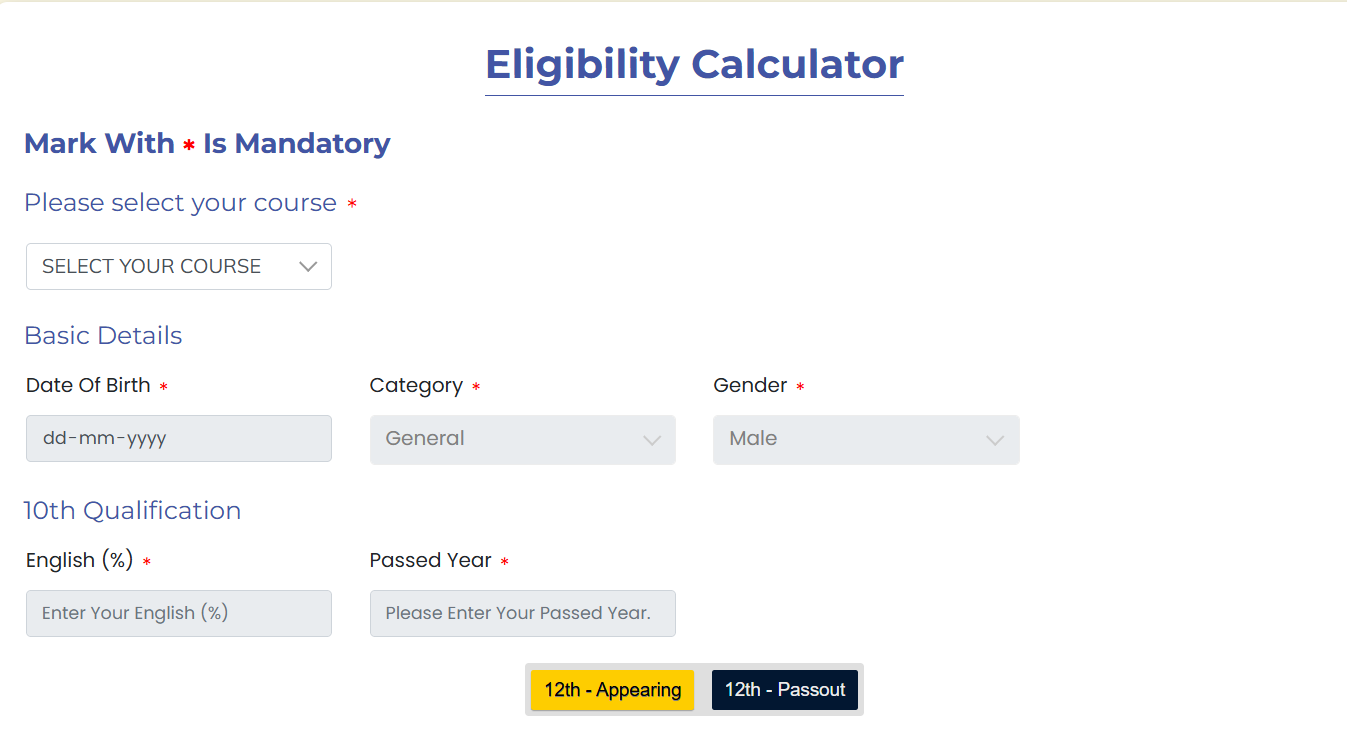
You can check your eligibility with the Merchant Navy Decoded eligibility calculator.
Step 3: Get Your Medical Fitness Checked
This step should ideally happen before you make a large financial commitment.
Book the required medical examination with a DGS-approved medical examiner and confirm that you meet the applicable standards.
For GP Crew under the nautical/deck department standard, DGS specifies unaided 6/6 vision in the better eye, 6/9 in the other eye, and normal color vision.
Checking this early can prevent a situation where a student pays for training and later discovers a medical issue that affects eligibility.
Step 4: Find a DGS-Approved GP Rating Institute
Do not select an institute simply because its advertisement says “Merchant Navy Course.”
DGS maintains official information on approved maritime training institutes and approved courses. Before paying any fee, verify that:
- The institute is approved by DGS.
- The GP Rating course is approved.
- The approval applies to the relevant admission period.
- The course being offered is actually the approved course.
- The institute has not been affected by a suspension or withdrawal order.
DGS provides separate sections for approved training institutes, approved courses, and orders concerning withdrawals or suspensions.
Step 5: Check the Institute’s Admission Process
The admission procedure can involve institute-level selection, entrance/selection procedures, or other requirements depending on the applicable rules and the institute.
DGS has issued regulations concerning the Common Entrance Test (CET) and online counselling for pre-sea maritime courses, along with subsequent amendments. Therefore, candidates should check the admission procedure applicable to their batch rather than assuming that every GP Rating institute follows exactly the same process.
If a shipping company or institute has a separate sponsorship or selection process, check its official notification carefully and understand the conditions before applying.
Step 6: Complete the Admission Formalities
Once you have selected an eligible institute and cleared the applicable admission requirements, complete the required documentation and admission formalities.
Keep your original academic and identity documents safely available, and make sure that the information submitted during admission matches your certificates.
Step 7: Complete the 6-Month GP Rating Training
The GP Rating pre-sea course is 6 months long.
The training prepares candidates for duties associated with both deck and engine watch functions and provides the foundation required for working in the rating category.
During this period, students should take their classroom training, practical training, assessments, and maritime safety-related training seriously.
Step 8: Complete the Required Assessments and Certification Process
Completing the course is not the end of the process.
DGS has continued to update the examination and certification framework for approved maritime training institutes. In 2025, DGS issued a revised framework for exit examinations for DGS-approved MTIs.
Therefore, students should complete the examinations, assessments, and certification requirements applicable to their course and batch.
Step 9: Move Towards the Seafaring Career
After completing the required training and certification formalities, the next stage is to pursue the applicable employment or shipboard pathway.
This can depend on the institute, company selection or sponsorship arrangements, documentation, medical fitness and the applicable DGS requirements.
It is important not to treat admission into a GP Rating course as an automatic guarantee of a shipboard job. Always understand what the institute or company is actually offering before paying fees.
SMVD Marine Academy for GP Rating Preparation After 10th
Once you decide to pursue GP Rating, proper preparation can help you become familiar with the type of entrance tests, interviews, and maritime subjects involved in the selection process.
SMVD Marine Academy offers offline GP Rating coaching and currently lists classroom training, tests, mentorship, and interview preparation among its offerings. Its official website also lists a GP Rating preparation book containing MCQs, concise theory, detailed solutions, and full-length practice papers.
SMVD Marine Academy also lists a GP Rating Test Series as part of its services. The test series is designed as structured practice to help aspirants work on accuracy, speed, and exam confidence.
For students who have completed Class 10 and plan to pursue GP Rating, SMVD Marine Academy can therefore be explored as an offline preparation option before entering the actual pre-sea training course.
However, coaching preparation and the actual DGS-approved GP Rating course are two different things. Students should separately verify the DGS approval of the institute where they intend to undertake the 6-month GP Rating pre-sea training.
Merchant Navy Decoded for GP Rating Guidance
Choosing a GP Rating college and understanding the admission process can sometimes be confusing because students have to compare eligibility, medical requirements, colleges, admission information, and preparation options.
Merchant Navy Decoded App provides digital maritime guidance and resources for students and seafarers. Its GP Rating section includes information about the course, eligibility, and colleges, while its platform also provides tools such as an eligibility calculator and college-related information.
For a student planning to enter through GP Rating after Class 10, Merchant Navy Decoded can be useful for exploring:
- GP Rating eligibility information
- GP Rating college information
- Eligibility Calculator
- Medical-related guidance
- Admission and form updates
- GP Rating preparation resources
- Maritime career information
The platform also provides a dedicated GP Rating contact channel and other maritime resources through its website and app.
In simple terms, SMVD Marine Academy is focused on offline preparation, while Merchant Navy Decoded provides digital information, tools, and guidance that can help students understand and navigate the GP Rating journey.
FAQ’s (Frequently asked Questions)
Yes. Candidates can enter the Merchant Navy through eligible rating-level routes after Class 10. GP Rating is the rating-level route covered in this article, subject to meeting the applicable DGS eligibility and medical requirements.
For the deck-and-engine rating route discussed here, GP Rating is the relevant pre-sea course. DGS also lists CCMC after Class 10, but that is a maritime catering course rather than a GP Rating deck/engine route.
Yes. Candidates entering seafaring training must satisfy the applicable DGS medical standards and undergo the required medical examination through a DGS-approved medical examiner.
Under the current DGS pre-sea eyesight standard for the nautical/deck department, which includes GP Crew, unaided distance vision must be 6/6 in the better eye and 6/9 in the other eye, with normal color vision tested by the Ishihara test.
No. GP Rating is a rating-level pre-sea training route. Becoming a Deck Officer follows a different officer-entry education and training pathway, which requires the prescribed 10+2 qualification and other requirements.
Not through the standard B.Tech Marine Engineering entry route. The current IMU eligibility requires 10+2 with physics, chemistry, and mathematics and the prescribed marks.
Yes. DGS lists the General Purpose Rating pre-sea course as a 6-month course.
Yes. It is sensible to establish your medical suitability before paying substantial admission fees because medical fitness is a mandatory part of seafaring eligibility. The examination should be carried out through a DGS-approved medical examiner.
First verify that the institute and the specific GP Rating course are approved by DGS. Then check the current admission process, medical requirements, course details, fees, sponsorship or placement terms and the institute’s current status before making a payment. DGS provides official sections for approved training institutes and approved courses.
